
Veneers vs Dental Implants: Which Fits You?

If you are weighing veneers vs dental implants, you are probably not looking for a lecture on dentistry. You want to know what will actually fix your smile, how long it will last, what it will cost, and whether it makes sense for your specific situation. That is the right place to start, because veneers and implants are not competing versions of the same treatment. They solve very different problems.
A veneer can improve the look of a tooth you still have. A dental implant replaces a tooth that is missing or needs to be removed. That one difference changes everything - the process, the cost, the recovery, and the long-term result.
Veneers vs dental implants: the core difference
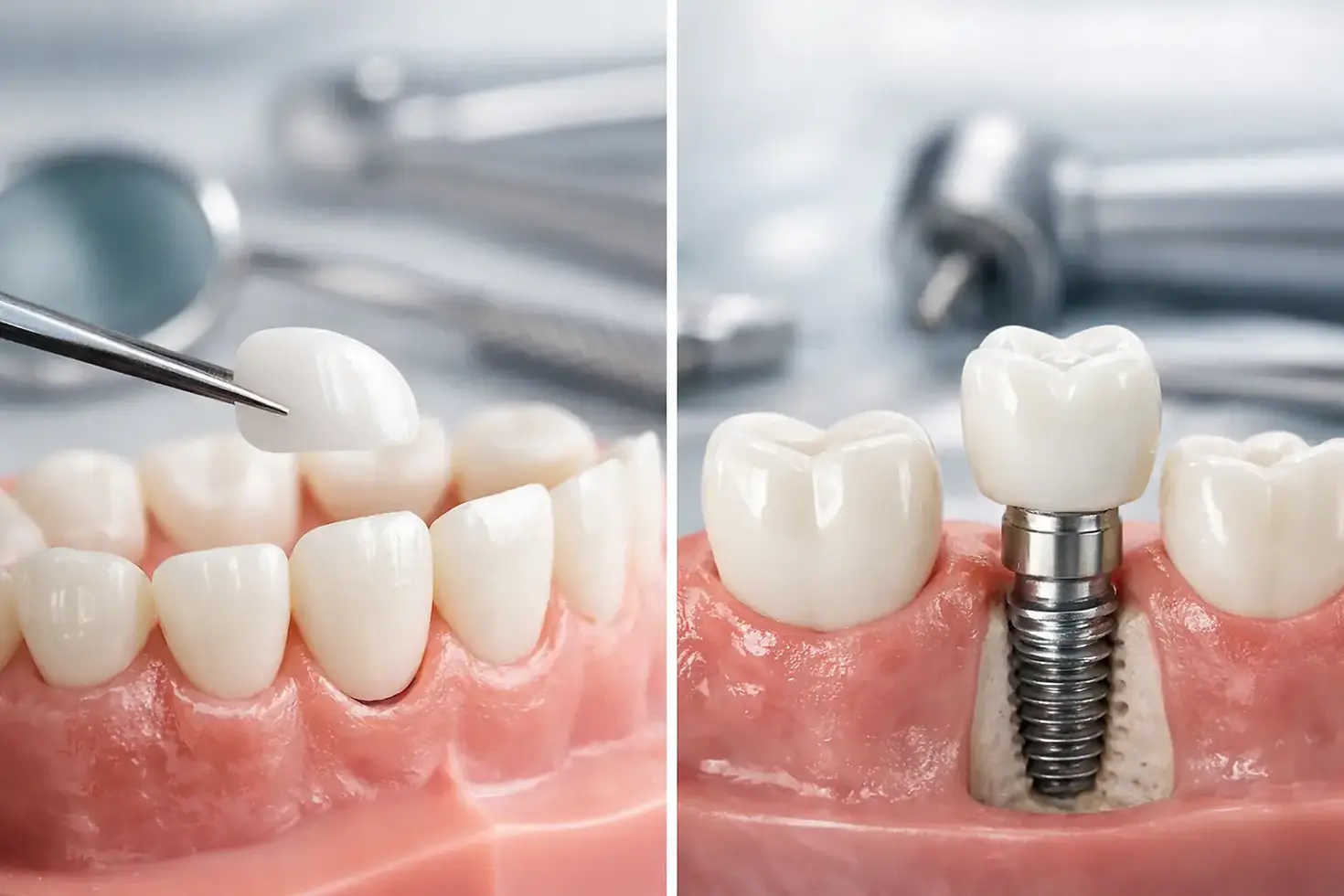
Think of veneers as a cosmetic upgrade and implants as a replacement solution. Veneers are thin porcelain shells bonded to the front of natural teeth. They are used to improve color, shape, spacing, small chips, and mild unevenness. They can create a dramatic smile makeover when the underlying teeth are healthy enough to support them.
Dental implants are artificial tooth roots, usually made from titanium, placed into the jawbone to support a crown, bridge, or full-arch restoration. They are designed to replace missing teeth and restore function as well as appearance. If you have a gap in your smile, a loose tooth, or a tooth that cannot be saved, veneers will not solve that problem. Implants can.
This is why the better question is often not veneers or implants. It is, what is wrong with the tooth, and what result do you want five or ten years from now?
When veneers make sense
Veneers are a strong option when your main concern is cosmetic. If your teeth are present, structurally stable, and healthy enough, veneers can deliver a brighter, more even smile with relatively little disruption to your daily life.
They are often a good fit for stains that whitening cannot fully correct, worn edges, minor chips, small gaps, or teeth that look too short or misshapen. For professionals and appearance-conscious patients, veneers can be appealing because the treatment timeline is usually shorter than implants and the visual transformation can be immediate.
But veneers do have limits. They do not treat infection under the tooth, severe decay, advanced gum disease, or missing teeth. They also require some enamel removal in many cases, which means the decision is typically irreversible. If a tooth is weak, cracked below the surface, or already failing, putting a veneer on it may improve the appearance for a while without fixing the real issue.
When dental implants are the better choice
Dental implants are built for a different level of problem. If a tooth is missing, badly broken, or beyond repair, an implant can replace it from the root up. That matters for more than looks.
When a tooth is gone, the jawbone in that area starts to shrink over time. Traditional cosmetic options do not stop that process. Implants help stimulate the bone and support the shape of your smile and face. They also let you bite and chew more naturally than removable options, which is a major quality-of-life issue for many patients.
If you are hiding your smile because of a missing front tooth, avoiding certain foods because of a back tooth, or dealing with dentures that move around, implants are often the more complete answer. They are not just about appearance. They are about security, comfort, and long-term stability.
At a practice focused on smile restoration like Chosen Implant Studio, that distinction matters. The goal is not just to make teeth look better in photos. It is to help patients eat, speak, and smile with confidence again.
Veneers vs dental implants on appearance
Both options can look highly natural when done well. Veneers are especially powerful for creating a polished, symmetrical smile because the dentist can control shape, shade, and proportion very precisely. If your goal is a brighter, camera-ready smile and your natural teeth are fundamentally healthy, veneers can be a beautiful solution.
Implants can also look extremely natural, especially when the restoration is customized to match your facial features and surrounding teeth. The difference is that implants are not just covering a visible flaw. They are rebuilding what is missing.
For a patient with one missing front tooth, a well-designed implant crown can blend so naturally that most people would never know it is not the original tooth. For someone missing several teeth, implants can restore smile structure in a way veneers simply cannot.
Cost and value are not the same thing
Cost is one of the biggest reasons patients hesitate, and that is understandable. Veneers often have a lower upfront cost per tooth than implants, especially when the tooth is healthy and no additional treatment is needed. That can make veneers feel like the easier choice.
But value depends on what you are treating. If you try to use a cosmetic fix where a true replacement is needed, lower cost upfront can lead to more treatment later. A failing tooth covered with a veneer may still need extraction and replacement down the road. In that case, the less expensive option was not really the smarter investment.
Implants typically cost more because they involve surgery, healing time, and a multi-step restorative process. Some patients also need bone grafting before implant placement. Still, implants are designed as a long-term solution. For many people, especially those dealing with missing teeth or repeated dental work on the same tooth, that durability changes the financial conversation.
Financing can also make advanced treatment more realistic than patients expect. That is one reason a clear consultation matters so much. You need to understand not just the price, but what that treatment is expected to accomplish.
Recovery and timeline
If speed is your main priority, veneers often win. Once planning is complete, the process is usually faster and less invasive. Patients are often back to normal quickly, with only minor short-term sensitivity.
Implants take longer. After placement, the implant needs time to integrate with the jawbone before the final crown or restoration is attached. Depending on your case, the full process can take several months. If extraction, grafting, or multiple implants are involved, the timeline can stretch further.
That said, slower does not mean worse. It means the treatment is doing more. You are not just improving the front surface of a tooth. You are rebuilding support under the gumline and creating a foundation meant to last.
Who is a candidate for each?
Veneer candidates usually need healthy teeth and gums, enough enamel, and cosmetic concerns that can be solved on the visible surface of the tooth. If you grind your teeth heavily or have untreated decay, those issues may need to be addressed first.
Implant candidates need adequate bone support and healthy gums, though not having enough bone does not always rule treatment out. Bone grafting can often make implants possible. Many patients also worry they are too old for implants, but age alone is rarely the deciding factor. Overall health, healing ability, and oral condition matter more.
This is where personalized guidance makes a difference. A good evaluation should tell you not just what you can do, but what makes sense for your goals, your budget, and your long-term oral health.
Veneers vs dental implants: which lasts longer?
Porcelain veneers can last many years with good care, but they are not lifetime restorations. They may need replacement due to wear, damage, gum recession, or changes in the underlying tooth.
Dental implants are built for long-term performance. The implant post itself can last decades, and in many cases much longer, if it is properly placed and maintained. The crown on top may eventually need replacement from normal wear, but the foundation is one of the strongest options in modern dentistry.
So if you are asking purely about longevity, implants usually have the edge. If you are asking about the right treatment for a healthy but cosmetically imperfect tooth, veneers may still be the better fit.
The best choice depends on the problem, not the trend
A lot of patients come in asking for veneers when what they really need is restorative work. Others assume they need an implant when the tooth can still be improved cosmetically. Neither treatment is better in every case. Better means more honest, more appropriate, and more likely to hold up over time.
If your tooth is present and healthy but does not look the way you want, veneers may be the right move. If the tooth is missing, failing, or compromising how you eat and speak, implants are usually the stronger answer.
The smartest next step is not guessing. It is getting a real evaluation from a team that understands both aesthetics and function, and that will tell you the truth about what your smile needs. The right treatment should not just change how you look. It should make daily life feel easier every time you talk, laugh, or sit down to eat.




Comments